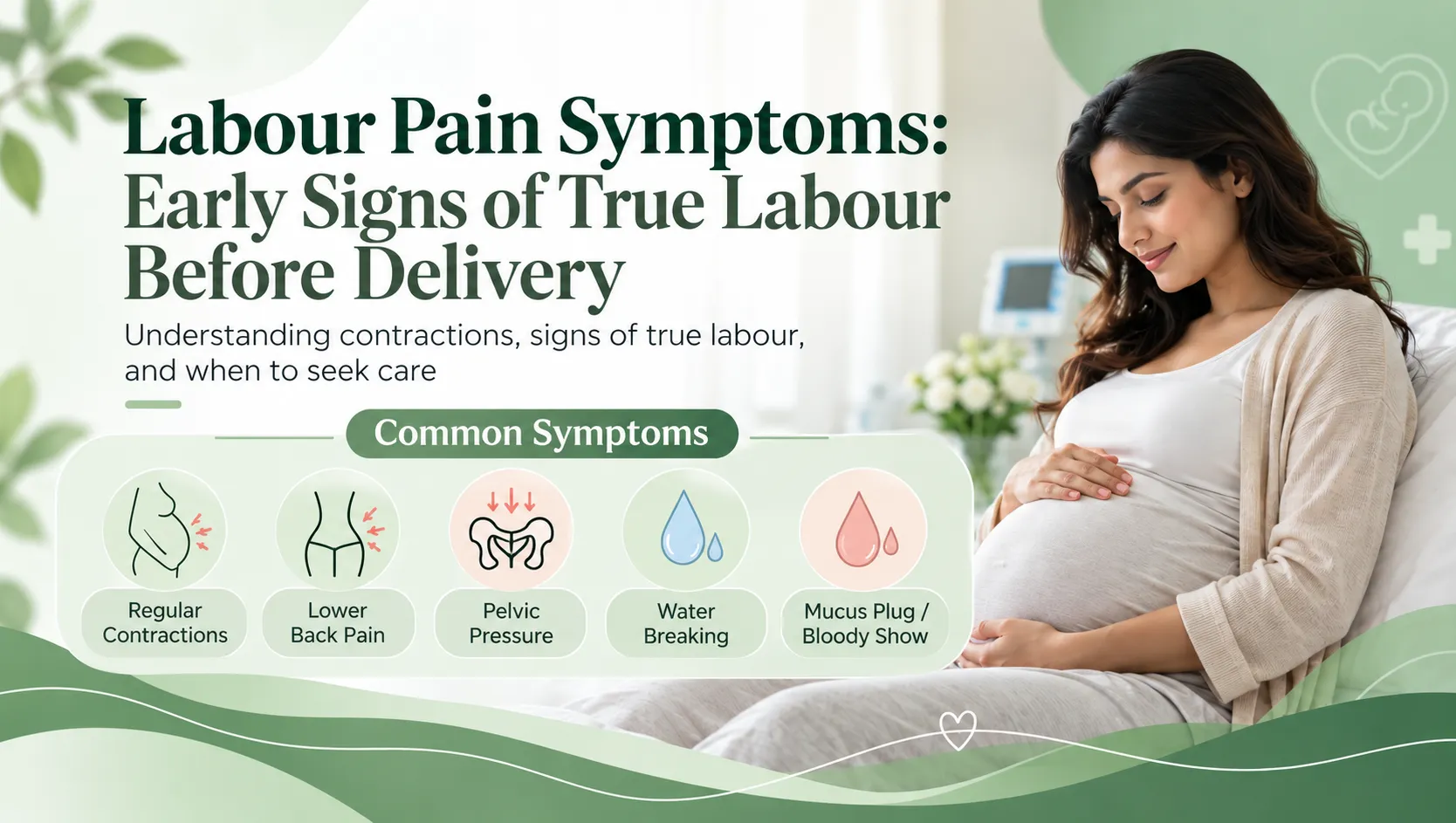
Labour pain symptoms commonly include regular uterine contractions, lower abdominal cramps, back pain, pelvic pressure, and increasing discomfort that gradually becomes stronger and more frequent. As delivery approaches, some women may also notice mucus discharge, a bloody show, or their water breaking.
Understanding labour pain symptoms before delivery can help you distinguish normal late-pregnancy discomfort from the signs of true labour. Every woman experiences labour differently, so symptoms may not always appear in the same order.
In this blog, we explain labour pain, true labour pain symptoms, delivery pain symptoms, how contractions feel, and when you should contact your doctor or go to the hospital.
What Is Labour Pain?
Labour pain occurs when the uterus begins contracting to help the cervix soften, thin and gradually open for childbirth.
During early labour, contractions may initially feel mild or irregular. As true labour progresses, they generally become:
-
Stronger
-
More regular
-
Longer-lasting
-
Closer together
The pain may be felt in the lower abdomen, lower back, pelvis or across the abdomen.
What Are the Common Labour Pain Symptoms?
The most common labour pain symptoms include:
1. Regular Contractions
Regular contractions are one of the strongest signs of true labour.
You may notice that contractions:
-
Come at increasingly regular intervals
-
Become stronger with time
-
Last longer
-
Become closer together
-
Continue despite rest or changing position
During each contraction, the abdomen may feel hard or tight before relaxing again.
2. Lower Abdominal Cramps
Early delivery pain symptoms may feel similar to menstrual cramps.
You may experience:
-
Lower abdominal pain
-
Tightening across the belly
-
Cramping that comes and goes
-
Increasing pelvic pressure
As labour progresses, these sensations generally become stronger.
3. Lower Back Pain
Some women experience labour pain mainly in the lower back.
The discomfort may:
-
Come with contractions
-
Spread toward the abdomen
-
Feel like pressure or aching
-
Increase gradually
Back pain alone does not always mean labour has started, but regular back pain with contractions can be a sign.
4. Pelvic Pressure
As the baby moves lower into the pelvis, you may experience:
-
Increased heaviness
-
Pressure in the lower abdomen
-
Frequent urination
-
A feeling that the baby has moved downward
-
Difficulty walking comfortably
Pelvic pressure can occur before labour, but it may become more noticeable as delivery approaches.
5. Mucus Plug or Bloody Show
As the cervix begins changing, the mucus plug may come out.
It may look:
-
Clear
-
White
-
Thick or jelly-like
-
Pink
-
Brownish
-
Slightly blood-streaked
Passing the mucus plug can be one of the labour pain symptoms before delivery, but labour does not necessarily begin immediately afterward.
6. Water Breaking
Water breaking occurs when the amniotic sac ruptures.
You may notice:
-
A sudden gush of fluid
-
A slow continuous trickle
-
Persistent wetness in your underwear
If you think your water has broken, contact your maternity care team even if labour pain has not started.
7. Abdominal Tightening
The abdomen may repeatedly become firm during contractions.
With true labour pain symptoms, the tightening generally becomes more regular, stronger and closer together.
8. Changes in Vaginal Discharge
As delivery approaches, you may notice:
-
Increased discharge
-
Thick mucus
-
Pinkish discharge
-
Blood-streaked mucus
Heavy vaginal bleeding, however, requires prompt medical attention.
What Are True Labour Pain Symptoms?
True labour pain symptoms usually follow a recognizable pattern.
Common signs include:
-
Contractions becoming regular
-
Pain gradually increasing
-
Contractions lasting longer
-
The time between contractions becoming shorter
-
Pain continuing despite rest
-
Lower back and abdominal pressure
-
Progressive cervical changes
These features help distinguish true labour from irregular practice contractions.
What Does Labour Pain Feel Like?
Labour pain can feel different for every woman.
It is commonly described as:
-
Strong menstrual-like cramps
-
Waves of abdominal tightening
-
Lower back pain
-
Pelvic pressure
-
Pain that builds, peaks and then eases
The uterus usually relaxes between contractions, providing a temporary break before the next contraction begins.
Where Does Labour Pain Start?
There is no single pattern.
For some women, labour pain begins in the lower abdomen.
For others, it may start in the lower back and move toward the abdomen.
Some women primarily experience pressure in the pelvis before stronger contractions begin.
Labour Pain Symptoms Before Delivery
Several changes may appear as delivery approaches.
Common labour pain symptoms before delivery include:
-
Increasingly regular contractions
-
Pelvic pressure
-
Lower back pain
-
Mucus plug discharge
-
Bloody show
-
Abdominal tightening
-
Water breaking
These symptoms may appear hours before delivery in some women and earlier in others.
What Are Delivery Pain Symptoms?
The term delivery pain symptoms is commonly used to describe the symptoms experienced when labour begins or progresses.
These can include:
-
Regular contractions
-
Lower abdominal pain
-
Back pain
-
Pelvic pressure
-
Increased vaginal mucus
-
Water breaking
The intensity and pattern of symptoms can vary significantly between pregnancies.
How Long Does Labour Pain Last Before Delivery?
There is no fixed duration.
The length of labour can depend on:
-
Whether this is the first pregnancy
-
Cervical dilation
-
Contraction strength
-
Baby's position
-
Individual pregnancy factors
Some women progress more quickly, while others may remain in early labour for longer.
How Often Do Labour Contractions Come?
In early labour, contractions may be farther apart and relatively mild.
As labour progresses, they usually:
-
Become more regular
-
Last longer
-
Increase in strength
-
Occur closer together
Your maternity team may provide specific guidance on when to come to the hospital based on your pregnancy and contraction pattern.
Can Labour Start Without Water Breaking?
Yes.
Many women begin experiencing labour pain symptoms before their water breaks.
The membranes may rupture later during labour, so you should not wait for water breaking before considering that labour may have started.
Can Water Break Without Labour Pain?
Yes.
For some women, the water breaks before regular contractions begin.
If this happens, contact your maternity care provider for advice and assessment.
When Should You Go to the Hospital?
Contact your doctor or maternity unit if:
-
Contractions become regular and increasingly painful
-
Your water breaks
-
You experience significant bleeding
-
Baby movements are noticeably reduced
-
You have severe or continuous abdominal pain
-
Fluid appears green or brown
-
You develop fever or feel unwell
-
Your doctor has advised you to come in
Labour Pain Before 37 Weeks
Labour-like symptoms before 37 weeks require prompt medical assessment because they may indicate preterm labour.
Possible symptoms include:
-
Regular contractions
-
Persistent lower back pain
-
Pelvic pressure
-
Menstrual-like cramps
-
Vaginal bleeding
-
Changes in vaginal discharge
-
Watery fluid leakage
Contact your doctor promptly if these symptoms develop before 37 weeks.
What Should You Do When Labour Pain Starts?
If you think labour has begun:
-
Start timing contractions.
-
Note how long each contraction lasts.
-
Observe whether they are becoming stronger.
-
Monitor your baby's movements.
-
Keep your hospital bag and medical records ready.
-
Contact your maternity care provider.
-
Follow the hospital's instructions about when to come in.
Do not take medication for labour pain without medical advice.
Conclusion
Labour pain symptoms commonly include regular contractions, lower abdominal cramps, back pain, pelvic pressure, mucus discharge and sometimes water breaking. The most important signs of true labour are contractions that become progressively stronger, longer and closer together.
However, every pregnancy and labour experience is different. If you experience regular contractions, water breaking, heavy bleeding, reduced baby movements or labour pain symptoms before delivery, contact your maternity care team for guidance.
For concerns related to labour pain, delivery pain symptoms, or pregnancy care, you can consult Dr. Smita Jain, IVF Specialist in Ghaziabad, for appropriate evaluation and pregnancy guidance.
Frequently Asked Questions About Labour Pain
1. What are the first signs of labour pain?
Early signs may include regular contractions, lower abdominal cramps, back pain, pelvic pressure, increased vaginal discharge, or passage of the mucus plug.
2. How can I tell if labour pain is real?
True labour contractions usually become stronger, longer, more regular, and closer together over time. They generally do not stop completely with rest or a change in position.
3. Where does labour pain usually start?
Labour pain may start in the lower abdomen, lower back, or pelvic area. In some women, the pain begins in the back and gradually moves toward the abdomen.
4. Can labour start without water breaking?
Yes. Many women start having regular contractions before their water breaks. The amniotic sac may rupture later during labour.
5. Can water break without labour pain?
Yes. In some pregnancies, the water may break before contractions begin. If this happens, contact your maternity care provider for guidance.
6. How long after labour pain starts does delivery happen?
There is no fixed timeline. Labour duration varies depending on whether it is the first delivery, cervical dilation, contraction pattern, baby’s position, and other individual factors.
7. Are baby boy labour pain symptoms different?
No. There are no specific labour pain symptoms that can reliably indicate a baby boy. Contractions, back pain, water breaking, and labour timing do not predict the baby’s sex.
8. Are baby girl labour pain symptoms different?
No. Labour pain symptoms for a baby girl are not medically different from those for a baby boy. Labour symptoms depend on the progress of childbirth, not the baby’s sex.
9. Can labour pain stop and start?
Yes, especially during early labour. Contractions may be irregular initially, but true labour usually becomes progressively more regular and stronger.
10. When should I go to the hospital for labour pain?
Contact your doctor or maternity unit if contractions become regular and stronger, your water breaks, there is significant bleeding, baby movements decrease, or labour-like symptoms occur before 37 weeks.